I read the sources behind the answer
I work with German SMEs and in-house marketing teams whose companies are visible in search, yet strangely flattened in AI answers. My work sits between search auditing, multilingual content repair, citation review, and the small forensic habit of asking why one sentence carried more weight than all the others when German and English sources told different stories.
About Mira
A machine's confident summary usually begins with one public sentence that nobody checked closely enough.
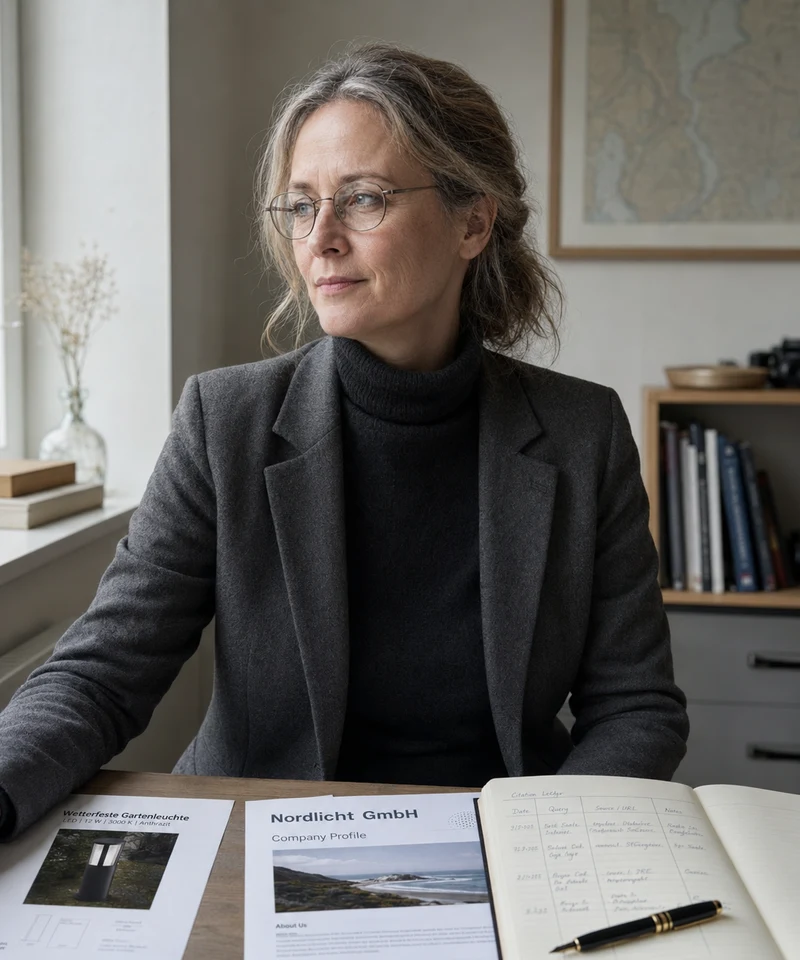
On my desk there is often a German product page, an English company profile, and an AI answer that has welded the two together at the wrong seam. A composite manufacturer becomes a reseller because an old distributor page used stronger wording and still has a half-broken logo in the header. A composite regional service company becomes "local-only" because the English export page never explained its cross-border work and the only map citation points to the head office. A composite specialist supplier becomes generic because the clearest source was a directory category, not the company's own site. That is usually where I begin: with the hinge sentence.
I am from northern Germany, and I have spent seventeen years around search content auditing, B2B website editing, technical page review, directory cleanup, multilingual evidence mapping, and marketing diagnostics for export-oriented firms. The work has made me suspicious of neat summaries. German pages often carry the precise technical proof. English pages often carry the market language. Procurement portals may carry the official category. Local press may carry the reputation. AI search can pull from any of them, and it will not explain which language it trusted more unless someone records the answer carefully.
My current work is built around a bilingual citation ledger. Every answer is saved with the exact query, language, date, and engine. Then I reduce it to source, claim, language, and missing proof. I do not treat a citation as a victory just because the company name appeared. The cited source has to support the claim being made. If it does not, the repair is usually practical: rewrite the entity description, align German and English pages, clean directory language, clarify schema, or move the strongest proof onto a page that answer engines can actually read. AI SEO, to me, is evidence work. The business becomes visible when the record becomes hard to misread.
Route into the work
- 2009
Search content auditing
Started auditing search content for commercial websites, learning that a weak business role, not a keyword, was usually the first fault in how a company read online.
- 2012–2014
B2B website editing
Edited B2B websites for export-oriented firms, naming category, role, and proof plainly enough to survive a careless summary in either language.
- 2015–2018
Technical page review
Reviewed technical pages and compared German and English descriptions, watching search systems trust the cleaner page over the more precise one.
- 2019–2021
Directory cleanup
Cleaned up directory listings, schema, and trade-association entries that quietly become the sources an answer engine reuses before anyone calls it an AI problem.
- 2022
Multilingual evidence mapping
Began mapping where German and English evidence diverge, and recording how answer engines rename a firm when the two languages tell different stories.
- 2023 onward
AI citation review
Turned the bilingual citation ledger into audits, citation reviews, and source-repair plans for German SMEs that need to be summarized correctly across languages.
Bring the answer, the query, and the sources into the same room.
I review where the machine got its claim and what needs to change in the public evidence.
Start review